

多线程并发编程笔记
线程池
基本概念
阻塞队列实现
class BlockingQueue<T> {
    //任务队列
    private Deque<T> deque = new ArrayDeque<>();
    //锁:防止线程竞争获取线程
    ReentrantLock lock = new ReentrantLock();
    //生产者条件变量
    private Condition fullWaitSet = lock.newCondition();
    //消费者条件变量
    private Condition emptyWaitSet = lock.newCondition();
    //容量
    private int capacity;

    public T take() {
        lock.lock();
        try {
            while (deque.isEmpty()) {
                try {
                    emptyWaitSet.await();
                } catch (InterruptedException e) {
                    throw new RuntimeException(e);
                }
            }
            fullWaitSet.signal();
            return deque.removeFirst();
        } finally {
            lock.unlock();
        }
    }

    public void put(T t) {
        lock.lock();
        try {
            while (capacity == deque.size()) {
                try {
                    fullWaitSet.await();
                } catch (InterruptedException e) {
                    throw new RuntimeException(e);
                }
            }
            deque.addLast(t);
            emptyWaitSet.signal();
        } finally {
            lock.unlock();
        }
    }

    public int size() {
        lock.lock();
        try {
            return deque.size();
        } finally {
            lock.unlock();
        }
    }
}
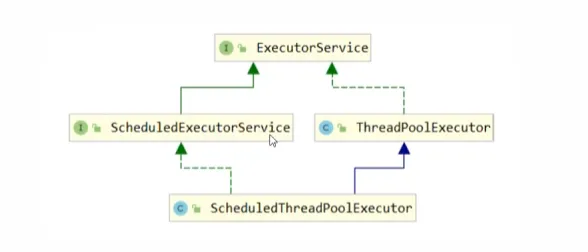
线程池继承图
线程池状态
ThreadPoolExecutor使用int的高三位表示线程池状态,低29为表示线程数量
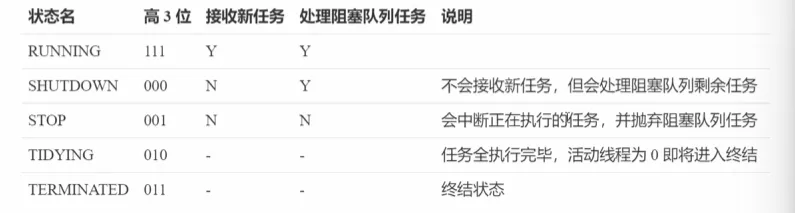
这是因为需要保证状态的原子性,组合起来可以用一次cas操作完成
ThreadPoolExecutor构造方法
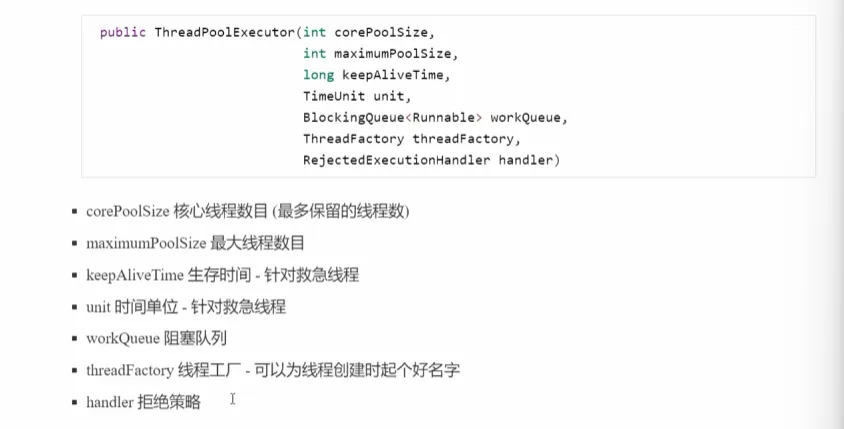
拒绝策略:
1.AbortPolicy:抛出异常
2.CallerRunsPolicy:让调用者运行任务
3.DiscardPolicy:放弃本次任务
4.DiscardOldestPolicy:放弃队列中最早的任务,用该任务代替
5.Dubbo:对于AbortPolicy增强,会记录日志
6.Netty:创建一个新的线程执行任务
7.ActiveMQ:等待超时(60s),如果有空位就放入
8.PinPoint:使用拒绝策略链,一次尝试每一种拒绝策略

Executor中一些线程池的实现,实际开发中不建议使用这些
固定大小线程池
newFixedThreadPool:核心线程数=最大线程数,阻塞队列是无界的
@Slf4j
public class Main {
    public static void main(String[] args) {
        ExecutorService pool = Executors.newFixedThreadPool(10);

        for (int i = 0; i < 10; i++) {
            int finalI = i;
            pool.execute(() -> log.info(String.valueOf(finalI)));
        }
    }
}@Slf4j
public class Main {
public static void main(String[] args) {
ExecutorService pool = Executors.newFixedThreadPool(10, new ThreadFactory() {
private AtomicInteger threadNumber = new AtomicInteger(1);
@Override
public Thread newThread(Runnable r) {
return new Thread(r, "pool-" + threadNumber.getAndIncrement());
}
});
for (int i = 0; i < 10; i++) {
int finalI = i;
pool.execute(() -> log.info(String.valueOf(finalI)));
}
}
}带缓冲的线程池
newCachedThreadPool:核心线程为0,创建的都是救急线程,空闲60s后被回收,救急线程可无限创建没有上限,SynchronousQueue没有容量,没有线程放不进去
适合任务数比较密集,但每个任务执行时间较短
单线程线程池
newSingleThreadExecutor:线程数固定为1,任务多余1的时候放入无界队列排队,任务执行完毕,唯一的线程也不会释放
自己创建一个线程串行执行任务,如果执行失败,线程就会被结束,队列中的其他任务就没法执行,这就是单线程线程池的功能,保证线程正常工作
线程池方法
execute:执行方法,传入Runnable接口实现类
pool.execute(() -> log.info(String.valueOf(finalI)));submit:执行方法,返回一个泛型结果,传入Callable接口实现类
实现有返回结果的线程运行用
@Slf4j
public class Main {
    public static void main(String[] args) throws Exception {
        ExecutorService pool = Executors.newFixedThreadPool(10, new ThreadFactory() {
            private AtomicInteger threadNumber = new AtomicInteger(1);
            @Override
            public Thread newThread(Runnable r) {
                return new Thread(r, "pool-" + threadNumber.getAndIncrement());
            }
        });

        Future<String> future = pool.submit(new Callable<String>() {
            @Override
            public String call() throws Exception {
                Thread.sleep(1000);
                log.info("返回String");
                return "String";
            }
        });
        String s = future.get();
        log.info("s: " + s);
    }
}
invokeAll:提交tasks中的所有任务
@Slf4j
public class Main {
    public static void main(String[] args) throws Exception {
        ExecutorService pool = Executors.newFixedThreadPool(10);
        List<Future<String>> futures = pool.invokeAll(
                Arrays.asList(
                        () -> {
                            log.info("return 1");
                            Thread.sleep(1000);
                            return "1";
                        },
                        () -> {
                            log.info("return 2");
                            Thread.sleep(2000);
                            return "2";
                        },
                        () -> {
                            log.info("return 3");
                            Thread.sleep(1400);
                            return "3";
                        }
                )
        );
        futures.forEach(future -> {
            try {
                log.info(future.get());
            } catch (InterruptedException | ExecutionException e) {
                throw new RuntimeException(e);
            }
        });
    }
}
invokeAny:不会执行全部任务,执行完其中的一个任务就将其返回,结束其他任务
@Slf4j
public class Main {
    public static void main(String[] args) throws Exception {
        ExecutorService pool = Executors.newFixedThreadPool(10);
        String str = pool.invokeAny(
                Arrays.asList(
                        () -> {
                            log.info("return 1");
                            Thread.sleep(1000);
                            log.info("end 1");
                            return "1";
                        },
                        () -> {
                            log.info("return 2");
                            Thread.sleep(2000);
                            log.info("end 2");
                            return "2";
                        },
                        () -> {
                            log.info("return 3");
                            Thread.sleep(1400);
                            log.info("end 3");
                            return "3";
                        }
                )
        );
        log.info("{}", str);
    }
}16:58:53.702 [pool-1-thread-3] INFO com.pool.Main -- return 3
16:58:53.702 [pool-1-thread-2] INFO com.pool.Main -- return 2
16:58:53.702 [pool-1-thread-1] INFO com.pool.Main -- return 1
16:58:54.717 [pool-1-thread-1] INFO com.pool.Main -- end 1
16:58:54.717 [main] INFO com.pool.Main -- 1shutdown:将线程池的状态变为SHUTDOWN(不会阻塞)
这里如果需要等待执行完(阻塞)需要使用awaitTermination方法
不会接受新的任务,会执行已提交任务,不会阻塞线程的执行
@Slf4j
public class Main {
    public static void main(String[] args) throws Exception {
        ExecutorService pool = Executors.newFixedThreadPool(10);
        for (int i = 0; i < 10; i++) {
            int num = i;
            pool.execute(() -> {
                log.info(num + ":start");
                try {
                    Thread.sleep(1000 * num);
                } catch (InterruptedException e) {
                    throw new RuntimeException(e);
                }
                log.info(num + ":end");
            });
        }
        Thread.sleep(1000 * 5);
        pool.shutdown();
//        pool.shutdownNow();
    }
}
shutdownNow会立即停止没有执行完的线程
工作线程
让有限的工作线程来异步轮流处理无限多的任务,可以将其归类为分工模式,他的典型实现就是线程池,也体现了经典设计模式的享元模式
不同的任务类型应该使用不同的线程池,这样就可以避免饥饿,并提升效率
饥饿
固定大小线程池会有饥饿现象,例如我们现在对于每个任务需要有两步处理,我们的线程都去执行第一步,而第二步没有空闲线程执行,这种情况就会出现饥饿现象(第二步永远不会被执行)
以下是一个点饭-做菜的场景,两个员工都跑去点餐了,没人做饭都在等待餐品,发生饥饿
@Slf4j
public class Main {
    public static void main(String[] args) throws Exception {
        ExecutorService pool = Executors.newFixedThreadPool(2);
        pool.execute(() -> {
           log.info("点餐");
           Future<String> future = pool.submit(() -> {
               log.info("做饭");
               return "饭";
           });
            try {
                log.info("上菜:" + future.get());
            } catch (InterruptedException | ExecutionException e) {
                throw new RuntimeException(e);
            }
        });
        pool.execute(() -> {
            log.info("点餐");
            Future<String> future = pool.submit(() -> {
                log.info("做饭");
                return "饭";
            });
            try {
                log.info("上菜:" + future.get());
            } catch (InterruptedException | ExecutionException e) {
                throw new RuntimeException(e);
            }
        });

    }
}
17:29:45.251 [pool-1-thread-2] INFO com.pool.Main -- 点餐
17:29:45.251 [pool-1-thread-1] INFO com.pool.Main -- 点餐饥饿解决
分工,不同的员工分类处理不同的任务,而单独增加数量是不能治本的
@Slf4j
public class Main {
    public static void main(String[] args) throws Exception {
        ExecutorService pool = Executors.newFixedThreadPool(2);
        ExecutorService Cooker = Executors.newFixedThreadPool(2);
        pool.execute(() -> {
           log.info("点餐");
           Future<String> future = Cooker.submit(() -> {
               log.info("做饭");
               return "饭";
           });
            try {
                log.info("上菜:" + future.get());
            } catch (InterruptedException | ExecutionException e) {
                throw new RuntimeException(e);
            }
        });
        pool.execute(() -> {
            log.info("点餐");
            Future<String> future = Cooker.submit(() -> {
                log.info("做饭");
                return "饭";
            });
            try {
                log.info("上菜:" + future.get());
            } catch (InterruptedException | ExecutionException e) {
                throw new RuntimeException(e);
            }
        });

    }
}
参数设置
过小的线程池不能充分的利用系统资源,容易导致饥饿
过大导致更多线程的上下文切换,占用更多的内存
CPU密集型:线程数=CPU核数+1(1保证操作系统的故障时线程顶上保证CPU不被浪费)
IO密集型:Web应用程序,当执行业务计算的时候,这个时候使用到CPU,当执行I/O操作的时候CPU就闲置下来了,可以利用多线程提高CPU利用率
线程数=CPU核数 * 期望利用率 * 总时间(CPU计算时间+等待时间)/ CPU计算时间
4核CPU计算时间是50%,期望CPU100利用
4 * 100% * 100% / 50% = 8
4核CPU计算时间是10%,期望CPU100利用
4 * 100% * 100% / 10% = 40
延时执行
Timer可以实现延时功能,Timer简单易用,但是所有任务都是同一个任务调度执行,所以任务都是串行的,如果一个任务延时后面的都会延时,发生异常后续任务也会被终止
@Slf4j
public class Main {
    public static void main(String[] args) {
        TimerTask task1 = new TimerTask() {
            public void run() {
                log.info("task 1");
                int i = 1 / 0;
            }
        };
        TimerTask task2 = new TimerTask() {
            public void run() {
                log.info("task 2");
            }
        };
        Timer timer = new Timer();
        timer.schedule(task1, 1000);
        timer.schedule(task2, 1000);
    }
}
21:22:52.096 [Timer-0] INFO com.time.Main -- task 1
Exception in thread "Timer-0" java.lang.ArithmeticException: / by zero
at com.time.Main$1.run(Main.java:14)
at java.base/java.util.TimerThread.mainLoop(Timer.java:566)
at java.base/java.util.TimerThread.run(Timer.java:516)ScheduledThreadPoolExecutor
@Slf4j
public class Main {
    public static void main(String[] args) {
        ScheduledExecutorService pool = Executors.newScheduledThreadPool(2);
        pool.schedule(() -> {log.info("Hello_1");}, 5, TimeUnit.SECONDS);
        pool.schedule(() -> {log.info("Hello_5");}, 1, TimeUnit.SECONDS);
    }
}
定时执行任务scheduleAtFixedRate
第三位是间隔的时间
@Slf4j
public class Main {
    public static void main(String[] args) {
        ScheduledExecutorService pool = Executors.newScheduledThreadPool(2);
        pool.scheduleAtFixedRate(() -> {log.info("Hello_3");}, 1, 3, TimeUnit.SECONDS);
        pool.scheduleAtFixedRate(() -> {log.info("Hello_5");}, 1, 5, TimeUnit.SECONDS);
    }
}
scheduWithFixedDelay是从任务结束开始计时
scheduleAtFixedRate:以固定的时间间隔(period)执行任务。如果任务执行时间小于period,则下一个任务在上一个任务完成后立即开始;如果任务执行时间大于period,则下一个任务会在上一个任务完成后立即开始,不会等待period。scheduleWithFixedDelay:在上一个任务完成后,等待固定的延迟时间(delay)再执行下一个任务。无论上一个任务的执行时间如何,都会在完成后等待delay再开始下一个任务。
异常处理
第一种解决:手动catch打印日志
ScheduledExecutorService pool = Executors.newScheduledThreadPool(2);
        pool.scheduleAtFixedRate(() -> {
            try {
                log.info("Hello_3");
                int i = 1 / 0;
            } catch (Exception e) {
                log.error("1/2=0");
            }
        }, 1, 3, TimeUnit.SECONDS);
第二种:借助Future对象,调用get时触发异常
@Slf4j
public class Main {
    public static void main(String[] args) throws ExecutionException, InterruptedException {
        ExecutorService pool = Executors.newFixedThreadPool(1);
        Future<Boolean> submit = pool.submit(() -> {
            log.info("task1");
            int i = 1 / 0;
            return true;
        });
        Boolean b = submit.get();
    }
}
定时任务
@Slf4j
public class Main {
    public static void main(String[] args) throws ExecutionException, InterruptedException {
        //当前时间和周四时间差
        long period = 1000 * 60 * 60 * 24;
        LocalDateTime now = LocalDateTime.now();
        LocalDateTime time = now.withHour(10).withMinute(0).withSecond(0).withNano(0).with(DayOfWeek.TUESDAY);

        long initailDelay = Duration.between(now, time).toMillis();
        ScheduledExecutorService pool = Executors.newScheduledThreadPool(1);
        pool.scheduleAtFixedRate(() -> {

        }, initailDelay, period, TimeUnit.MILLISECONDS);

    }
}
Fork/Join
体现的是分治思想,将任务拆分,将计算的结果合并
例如递归,分支之类的我们用Fork加入多线程,将小任务使用不同线程完成,进一步提升计算效率
Fork/Join默认创建与cpu核心数大小相同的线程池
public class Main {
    public static void main(String[] args) {
        ForkJoinPool pool = new ForkJoinPool(4);
        System.out.println(pool.invoke(new TaskReturn(5)));
    }
}

class TaskReturn extends RecursiveTask<Integer> {
    private int n;
    public TaskReturn(int n) {
        this.n = n;
    }
    @Override
    protected Integer compute() {
        if(n == 1) {
            return 1;
        }
        //创建下一个任务
        TaskReturn taskReturn = new TaskReturn(n - 1);
        //执行任务
        taskReturn.fork();
        //得到的结果加上当前的n
        return taskReturn.join() + n;
    }
}
或者二分
@Slf4j
class TaskReturn extends RecursiveTask<Integer> {
    private int begin;
    private int end;

    public TaskReturn(int begin, int end) {
        this.begin = begin;
        this.end = end;
    }

    @Override
    protected Integer compute() {
        if (begin > end) {
            return 0;
        }
        if (begin == end) {
            return begin;
        }
        int mid = (begin + end) / 2;
        TaskReturn taskReturn1 = new TaskReturn(begin,  mid);
        TaskReturn taskReturn2 = new TaskReturn(mid + 1,  end);
        taskReturn1.fork();
        taskReturn2.fork();
        return taskReturn1.join() + taskReturn2.join();
    }
}
无结果的情况:使用RecursiveAction
public class Main {
    public static void main(String[] args) {
        ForkJoinPool pool = new ForkJoinPool(3);
        pool.invoke(new Task(5));
    }
}

@Slf4j
class Task extends RecursiveAction {
    int value;

    public Task(int value) {
        this.value = value;
    }

    @Override
    protected void compute() {
        if (value <= 0) {
            return;
        }
        Task next = new Task(value - 1);
        next.fork();
        log.info(value + "");
        next.join();
    }
}
17:04:54.357 [ForkJoinPool-1-worker-1] INFO com.fork.Task -- 5
17:04:54.357 [ForkJoinPool-1-worker-2] INFO com.fork.Task -- 4
17:04:54.357 [ForkJoinPool-1-worker-3] INFO com.fork.Task -- 3
17:04:54.362 [ForkJoinPool-1-worker-2] INFO com.fork.Task -- 1
17:04:54.362 [ForkJoinPool-1-worker-1] INFO com.fork.Task -- 2