

Java笔记
枚举类
在设计一个季节对象的时候,我们可以用传统的方式实现
public class Enumeration {
    Season season = new Season("春天", "温暖");
}

class Season {
    private String season;
    private String description;
    Season(String season, String description) {
        this.season = season;
        this.description = description;
    }
}
但是众所周知,季节只有四季,不能体现只有四个这个特征,为了解决这个问题,我们可以使用枚举类来定义季节,设计几个有限的值
枚举定义
是一组常量的集合:枚举是一种特殊的类,里面只包含一组有限的特定对象
自定义枚举
1.不需要提供set方法,因为枚举对象通常是只读的
2.写枚举对象/属性的使用一般用final + static 修饰
3.枚举对象名通常用大写来命名,常量的命名规范
4.枚举对象根据需要也可以拥有多个属性
使用方式1
1.私有化构造器,防止直接new
2.删去set方法,防止属性修改
3.在Season内部直接创建固定对象
public class Enumeration {
    Season season = Season.SPRING;
}

class Season {
    private String season;
    private String description;

    public static final Season SPRING = new Season("春天", "温暖");
    public static final Season SUMMER = new Season("夏天", "炎热");
    public static final Season AUTUMN = new Season("秋天", "凉爽");
    public static final Season WINTER = new Season("冬天", "寒冷");

    private Season(String season, String description) {
        this.season = season;
        this.description = description;
    }
}
使用方式2
使用关键字enum
使用细节
1.要将枚举对象放在枚举类的行首
2.常量之间用“,”间隔
3.常量通过构造器构造,必须知道用哪一个构造器
4.使用无参构造器的时候可以省略形参列表和小括号
public class Enumeration {
    Season season = Season.SPRING;
}

enum Season {
    SPRING("春天", "温暖"),
    SUMMER("夏天", "炎热"),
    AUTUMN("秋天", "凉爽"),
    WINTER("冬天", "寒冷");

    private String season;
    private String description;

    private Season(String season, String description) {
        this.season = season;
        this.description = description;
    }
}
5.当使用enum关键字开发一个枚举类的时候,默认继承了Enum类
这里可以运用反编译来进行证明
PS C:\Users\71460\Desktop\Java\IDEA\chapter11\out\production\chapter11\com\enum_> javap Season.class
Compiled from "Enumeration.java"
final class com.enum_.Season extends java.lang.Enum<com.enum_.Season> {
  public static final com.enum_.Season SPRING;
  public static final com.enum_.Season SUMMER;
  public static final com.enum_.Season AUTUMN;
  public static final com.enum_.Season WINTER;
  public static com.enum_.Season[] values();
  public static com.enum_.Season valueOf(java.lang.String);
  static {};
}
Enum类
关键enum字修饰的类隐式的继承了Enum类,这个类中有一些常用的方法
挨个解释有点麻烦,这里直接上代码示例
public class Enumeration {
    public static void main(String[] args) {
        Season season = Season.WINTER;
        System.out.println(season.toString());// WINTER 输出枚举的名字
        System.out.println(season.name());// WINTER 输出枚举的名字
        System.out.println(season.ordinal());// 3 输出枚举对象的次序,从0开始编号
        for (Season s : Season.values()) {
            System.out.println(s.toString()); // 输出一个枚举常量的数组
        }
        Season season2 = Season.valueOf("SPRING");// 用valueOf可以将字符串转为枚举常量
        System.out.println(season2.compareTo(season));
        //-3 比较两个枚举类型,return self.ordinal - other.ordinal;
    }

}

enum Season {
    SPRING("春天", "温暖"),
    SUMMER("夏天", "炎热"),
    AUTUMN("秋天", "凉爽"),
    WINTER("冬天", "寒冷");

    private String season;
    private String description;

    private Season(String season, String description) {
        this.season = season;
        this.description = description;
    }
}
Enum使用细节
1.enum不可以继承其他类,因为已经继承了Enum父类
2.枚举类和普通类一样可以实现接口
public class Homework {
    public static void main(String[] args) {
        Week week = Week.TUESDAY;
        week.doSomething();
    }
}

interface Doing {
    void doSomething();
}

enum Week implements Doing {
    MONDAY("星期一"),
    TUESDAY("星期二"),
    WEDNESDAY("星期三");

    private String name;
    private Week(String name) {
        this.name = name;
    }

    @Override
    public void doSomething() {
        System.out.println(name);
    }

    @Override
    public String toString() {
        return name;
    }
}
注解
定义
注解(Annotation)也被称为元数据(Metadata)
1.用于修饰包,类,方法,属性,构造器,局部变量的数据信息
2.和注释一样,注解不影响程序逻辑,但是注解可以被编译运行,相当于嵌入在代码中的补充信息
3.在JavaSE中,注解使用的目的比较简单,例如标记过过时的功能,忽略警告等
4.在JavaEE中注解占据了更加重要的角色,例如配置应用程序的任何切面,代替JavaEE旧版中所遗留的,繁冗代码和XML配置等
三个基本的Annotation
@Override
限定某个方法,是重写父类方法,该注解只可以用于方法
源码中的override注解说明,其中@target是注解注解的注解
@Target(ElementType.METHOD)
@Retention(RetentionPolicy.SOURCE)
public @interface Override {
}
加上了这个注解,编译器会检查子类是否重写父类方法,如果没有重写会报错
class Father {
    public Father() {}
    public void Print() {
        System.out.println("Father");
    }
}

class Child extends Father {
    public Child() {}
    @Override//加上了override注解
    public void Print() {
        System.out.println("Child");
    }
}
@Deprecated
可以做版本过渡使用(保证了兼容性)
用于表示某个程序元素(类,方法等)已过时,可以修饰方法,字段,包,参数,类,局部变量,类型等
@Documented
@Retention(RetentionPolicy.RUNTIME)
@Target(value={CONSTRUCTOR, FIELD, LOCAL_VARIABLE, METHOD, PACKAGE, PARAMETER, TYPE})
public @interface Deprecated {
}
在以下代码中表示Child类以及过时,但是还是可以使用,只是不建议使用
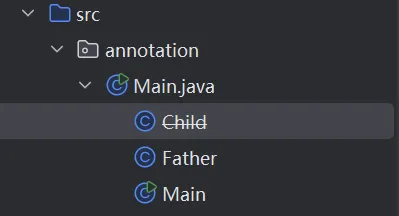
@Deprecated
class Child extends Father {
    public Child() {}
    @Override
    public void Print() {
        System.out.println("Child");
    }
}
@SuppressWarnings
抑制编译器警告
@Target({TYPE, FIELD, METHOD, PARAMETER, CONSTRUCTOR, LOCAL_VARIABLE})
@Retention(RetentionPolicy.SOURCE)
public @interface SuppressWarnings {
    String[] value();
}
在编写代码的时候,往往会出现一些黄色的线条勾选部分代码,如果在合理的范围中你不想见到这一些警告,你可以使用@SuppressWarnings不显示一些警告信息
public class Main {
    public static void main(String[] args) {
        List list = new ArrayList();
        list.add("her");
        list.add("he");
        list.add("it");
        System.out.println(list.get(0));
    }
}
以下是使用方式
public class Main {
    @SuppressWarnings({"all"})//忽略编译警告
    public static void main(String[] args) {
        List list = new ArrayList();
        list.add("her");
        list.add("he");
        list.add("it");
        System.out.println(list.get(0));
    }
}
在{ }中填入对应需要忽略的警告信息,有点类似字符串数组的静态创建(其实本质就是一个字符串数组,可以查看jdk源码验证)
String[] value();另外该注解的作用范围和注解的位置有关,像如上代码中抑制的范围是main方法中,或者更大的范围可以放在类上
JDK中的元注解
修饰注解的注解,再查看注解源码的时候可以用元注解了解注解相应作用即可
@Retention注解的作用范围
@Target使用位置
@Documented 是否在javadoc中体现
@inherited 子类会继承父类注解(使用较少)
以下是一个例子
@Documented//会显示在javadoc文档
@Retention(RetentionPolicy.RUNTIME)//注解的注解范围(源码,类,运行时)
@Target(value={CONSTRUCTOR, FIELD, LOCAL_VARIABLE, METHOD, PACKAGE, PARAMETER, TYPE})//注解的使用场景
public @interface Deprecated {
}
异常
概念
异常的概念
在Java中,将程序执行过程中发生的不正常情况称为异常
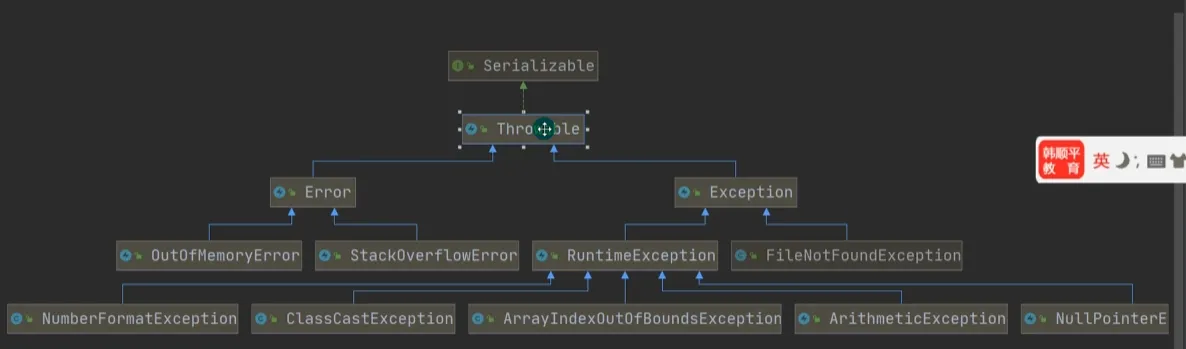
分为两大类:Error错误以及Exception
Error: Java 虚拟机无法解决的严重问题例如JVM系统内部错误,资源溢出
Exception:由于编程错误或者偶然的外在因素导致的一般性问题,可以使用针对性地代码进行处理,异常又分为两大类,一种是编译时异常,另一种是运行时异常。
异常体系图
异常中又分为编译时异常(javac),运行时异常(java)
异常处理概念
如果程序员认为代码会出现异常,可以使用try-catch异常处理机制来解决
在程序运行的过程中有可能会发送各种异常,而发生程序异常的时候,程序往往发成崩溃
public class Exception01 {
    public static void main(String[] args) {
        int num1 = 10;
        int num2 = 0;
        System.out.println(num1 / num2);
        System.out.println("程序运行完毕");
    }
}
这一段代码不会输出最后运行完毕的提示消息,在写程序的时候不应该因为一个微小地异常而导致整个程序崩溃,我们可以通过运用异常处理机制来解决这个问题
用ctrl alt + t -> 选中try-catch,如果异常处理,即使出现异常程序也可以正常执行
public class Exception01 {
    public static void main(String[] args) {
        int num1 = 10;
        int num2 = 0;
        try {
            System.out.println(num1 / num2);
        } catch (Exception e) {
            System.out.println("异常被捕获");
        }
        System.out.println("程序运行完毕");
    }
}
输出结果
异常被捕获
程序运行完毕
常见的异常
运行时异常
空指针异常 NullPointerExceprion
public class Exception01 {
    public static void main(String[] args) {
        String name = null;
        try {
            name.toString();
        } catch (NullPointerException e) {
            System.out.println("异常被捕获");
        }
        System.out.println("程序运行完毕");
    }
算数异常 ArithmeticException
public class Exception01 {
    public static void main(String[] args) {
        int num1 = 10;
        int num2 = 0;
        try {
            System.out.println(num1 / num2);
        } catch (ArithmeticException e) {
            System.out.println("异常被捕获");
        }
        System.out.println("程序运行完毕");
    }
}
数组越界访问异常 ArrayIndexOutOfBoundsException
public class Exception01 {
    public static void main(String[] args) {
        int[] arr = {1, 3, 4, 6, 7};
        try {
            System.out.println(arr[5]);
        } catch (ArrayIndexOutOfBoundsException e) {
            System.out.println("异常被捕获");
        }
        System.out.println("程序运行完毕");
    }
}
类型转换异常 ClassCastException
解释说明:当将对象试图转换为不是实例的子类的时候会发生该异常
public class Exception01 {
    public static void main(String[] args) {
        A a = new B();
        B b = (B) a;
        try {
            C c = (C) a;
        } catch (ClassCastException e) {
            System.out.println("异常被捕获" + e.getMessage());
        }
        System.out.println("程序运行完毕");
    }
}

class A {
}

class B extends A {
}

class C {
}
但是这里没有捕获到异常,程序崩溃(暂时未知原因,丢给AI解释说是和开发环境以及缓存有关,后续会查证)
数字格式不正确 NumberFormatException
public class Exception01 {
    public static void main(String[] args) {
        String name = "thrinisty";
        try {
            int num = Integer.parseInt(name);
        } catch (NumberFormatException e) {
            System.out.println("异常被捕获" + e.getMessage());
        }
        System.out.println("程序运行完毕");
    }
}
编译时异常
在编译期间就必须要处理的异常,否则代码不通过编译
例如无对应文件异常,数据库异常等,在后续学习文件IO时候会进行补充
处理异常的方式
二选一即可
try-catch-finally
程序员在代码中捕获发送的异常,自行处理
try {
   	//代码可能会出现异常,将异常封装为Exception对象e,传递catch
} catch (Exception e) {
   	//异常传递给catch
   	//用e来进行自定义处理
} finally {
    //(可以不写finally)
   	//不管try代码块是否有异常,始终要执行finally
    //一般是用来在这里进行资源关闭
}
使用细节:
1.如果异常发生,则catch中异常后的代码不再执行
package com.npu;

/**
 * @author 李昊轩
 * @version 1.0
 */
public class Exception01 {
    public static void main(String[] args) {
        String name = "thrinisty";
        try {
            int num = Integer.parseInt(name);
            System.out.println("try 异常之后的代码");//不执行
        } catch (NumberFormatException e) {
            System.out.println("异常被捕获" + e.getMessage());
        } finally {

        }
        System.out.println("程序运行完毕");
    }
}
2.如果没有发生异常,catch代码块不会被执行
3.finally中的内容无论异常是否被接收都会被执行,一般用于释放资源
4.可以有多个catch语句,捕获不同的异常,要求父异常写在后,子异常在前例如
package com.npu;

/**
 * @author 李昊轩
 * @version 1.0
 */
public class Exception01 {
    public static void main(String[] args) {
        String name = "thrinisty";
        try {
            int num = Integer.parseInt(name);
            System.out.println("try 异常之后的代码");
        } catch (NumberFormatException e) {
            System.out.println("转换异常被捕获" + e.getMessage());
        } catch (Exception e) {
            System.out.println("异常发生");
        } finally {
            System.out.println("finally");
        }
        System.out.println("程序运行完毕");
    }
}
5.try-finally配合使用:用于执行一段代码,之后无论异常是否发生,都会执行finally代码块
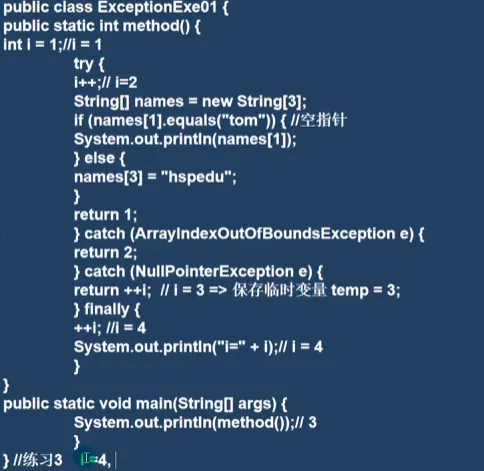
一个容易出错的题目:
throws
将发生的异常抛出,交给调用者(方法)来进行处理,最顶端的处理者是JVM
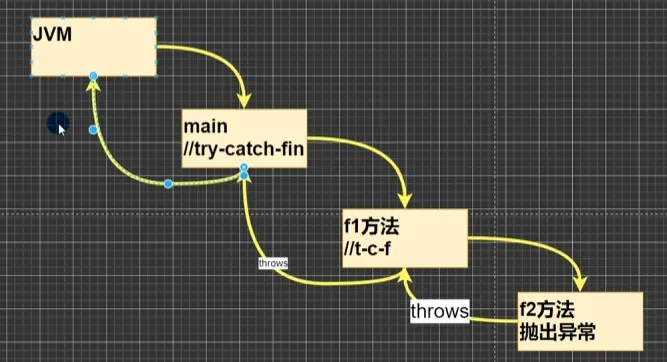
假如在代码中没有进行throw显示的处理,而发生了异常,就会默认的抛出异常依次传递直到JVM处理异常,退出程序
代码示例
package com.npu;

import java.io.FileInputStream;
import java.io.FileNotFoundException;
import java.util.Scanner;

/**
 * @author 李昊轩
 * @version 1.0
 */
public class Exception01 {
    public static void main(String[] args) {
        try {
            m1();
        } catch (FileNotFoundException e) {
            System.out.println("File not found");
        }
    }

    public static void m1() throws FileNotFoundException {
        FileInputStream fis = new FileInputStream("cd");
    }
}
异常交予main函数进行处理,抛出的异常可以是一个列表,对应的异常,异常的父异常
异常使用细节
1.编译异常必须处理
2.对于运行时异常,程序中没有进行处理默认为throws方式处理
3.子类重写父类方法的时候,要么抛出异常的规定,子类重写方法,所抛出的异常类型要和父类抛出的异常一致,要么为父类抛出异常类型的子类型
class Father {
    public void sayHello() throws Exception {}
}

class Son extends Father {
    public void sayHello() throws IOException {}
}//子类不可以扩大异常范围
4.运行异常可以默认处理,但是编译异常必须显示的处理
课堂练习
输入整数,不是整数就继续输入
public class Exception01 {
    public static void main(String[] args) {
        Scanner sc = new Scanner(System.in);
        int num = 0;
        System.out.print("输入一个整数 ");
        while (true) {
            try {
                num = Integer.parseInt(sc.nextLine());
                break;
            } catch (Exception e) {
                System.out.println("请重新输入...");
            }
        }
        System.out.println(num);
    }
}
自定义异常
使用步骤:
1.定义类:自定义异常类名,继承Exception或者RuntimeException
2.继承Exception属于编译异常
3.继承RuntimeException是运行异常
通过throw关键字抛出对应的自定义异常,并运用构造器传入异常信息
public class Exception01 {
    public static void main(String[] args) {
        int age = 15;
        try {
            test(age);
        } catch (TypeException e){
            System.out.println(e.getMessage());
        }
    }

    public static void test(int age) {
        if(age < 18) {
            throw new TypeException("年龄要在18岁以上");
        }
    }
}

class TypeException extends RuntimeException {
    public TypeException(String message) {
        super(message);
    }
}
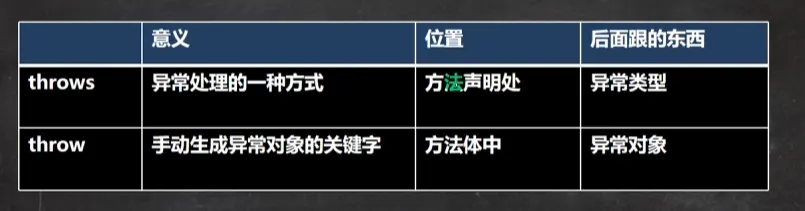
throw与throws
到此枚举类,注解,异常处理的部分结束